
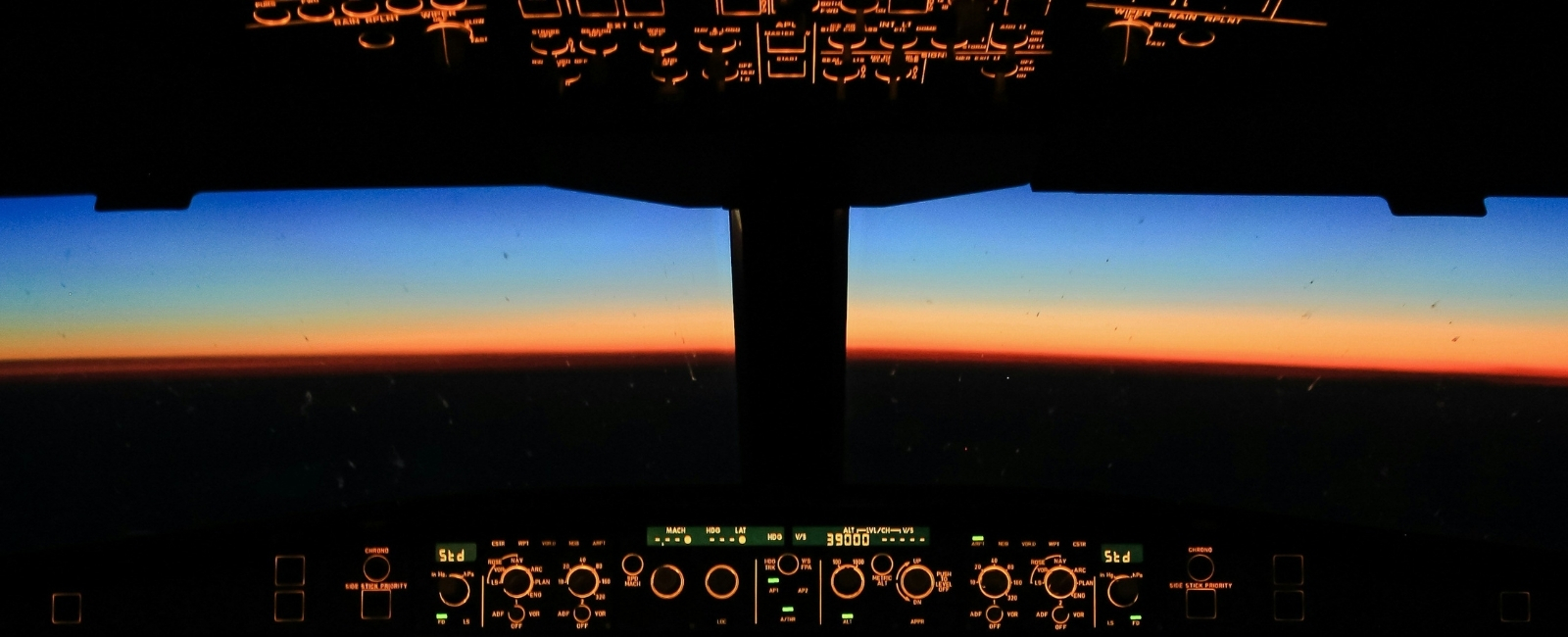

A look at the flight controls and avionics that make eVTOL aircraft fly the way they should.
The Hardest Moment in Flight
Watch a helicopter hover and you see something a fixed-wing airplane simply cannot do. Watch an airplane cruise at altitude and you see efficiency a helicopter cannot match. For a century, aviation engineers have lived with that tradeoff. You picked one or the other, and you designed everything else around the choice.
Powered-lift aircraft like modern eVTOLs are trying to do both. They lift off like a helicopter, fly like an airplane, and have to gracefully transition between those two very different ways of staying in the air. The transition phase, that handoff between hovering on motor thrust and flying on wing lift, is the moment when flight controls and avionics earn every dollar that went into them.
It is also where the engineering gets most interesting.
Why Powered-Lift Breaks the Old Rules
You cannot just take a helicopter avionics package and bolt it onto an eVTOL. You cannot take a small airplane autopilot and teach it to hover. The differences run deeper than that. Powered-lift aircraft typically have multiple independent thrust sources instead of a single main rotor or a single engine. They operate across a flight envelope that includes hover, transition, and cruise, each with its own physics and its own failure modes. And perhaps most importantly, the people who will eventually fly and ride in these aircraft expect something closer to car-like simplicity than to the workload of a traditional helicopter cockpit.
That last point matters more than it might sound. Avionics design is not just about controlling the aircraft. It is about controlling it in a way that an average pilot, and eventually an average passenger, can trust.
The Three Jobs of a Flight Control System
Strip away the acronyms and the math, and every flight control system does the same three things.
- It senses what the aircraft is doing. Speed, altitude, attitude, position, motor health, battery state, wind, and dozens of other variables come streaming in from sensors scattered around the airframe.
- It decides what the aircraft should be doing. That decision could come from a pilot’s stick input, an autopilot following a planned route, or an automatic safety system reacting to something unexpected.
- It moves the right things to close the gap between what is happening and what should be happening. Motors spin faster or slower, control surfaces deflect, and the aircraft responds.
That is the whole loop, repeated hundreds of times per second. Everything else is detail.
Sensing: More Is Not Always Better
It is tempting to think the answer to safety is more sensors. More accelerometers, more GPS receivers, more airspeed probes, more cameras. In practice, the interesting engineering question is not what you can add but what you can trust.
Every sensor adds weight, wiring, software complexity, and one more thing that can fail. Worse, sensors can fail in subtle ways. A GPS receiver that quietly drifts is more dangerous than one that goes completely dark, because a system that does not know it has bad data may act on it.
Modern flight controllers use sensor fusion to build a single coherent picture of what the aircraft is doing by combining inputs from multiple sources and weighing them against each other. The skill is not in collecting data. It is in knowing which data to believe.
Deciding: Where Software Meets Airmanship
This is where vertical lift aircraft diverge most from everything that came before. A helicopter pilot manages collective, cyclic, pedals, and throttle. A fixed-wing pilot manages stick, rudder, and throttle. An eVTOL pilot, if the design is done right, manages something much simpler, and the flight control software handles the complexity underneath.
In hover, the software is coordinating thrust across multiple lift motors to hold position. In cruise, it is managing control surfaces and forward thrust the way a traditional autopilot would. In the transition between those two regimes, it is blending authority between the lift motors and the wings, watching airspeed build, and deciding moment by moment how much of the aircraft’s weight should be carried by thrust versus lift.
The pilot should not have to think about any of that. The whole point of good flight control design is to hide the complexity so the pilot can focus on flying the mission, not on managing motor states. In fact, it should be as simple as things such as “fly me forward,” “rotate,” or “land.” Intuitive commands that don’t require knowledge of a complex aircraft to fly.
Acting: The Wiring Beneath the Wings
The way commands reach the hardware has changed dramatically in the last twenty years. Older aircraft used heavy mechanical linkages, cables, pulleys, and pushrods to move control surfaces. Modern aircraft are moving toward digital networks where a small flight computer can command dozens of actuators and motors over a single pair of wires.
This shift is not unique to aviation. The same architectural change is happening in electric cars, industrial robotics, and even high-end consumer drones. In fact, a lot of eVTOL development benefits from the lessons learned in electric cars specifically, including a much broader wave of innovation in distributed control, smart actuators, and reliable digital communication. What was exotic in aerospace even ten years ago is now standard practice across multiple industries, which means better components at lower cost and with more mature software.
Designing for Things Going Wrong
This is where serious aircraft design lives. Anyone can build something that works when everything goes right. The job is to build something that still works, or at least fails gracefully, when something goes wrong.
A few principles guide that work. Redundancy is not just duplication. Two identical parts tend to fail in identical ways, often at the same time, often for the same reason. Good redundancy uses different mechanisms to back each other up, so that the thing which kills the primary system does not also kill the backup.
Graceful degradation matters more than perfection. No aircraft is immune to failures. What separates a well-designed aircraft from a poorly-designed one is whether the next-best option is always available. If a motor fails, can the others compensate? If a sensor goes bad, can the system recognize it and ignore it? If a communication link drops, is there a sensible default?
Chuck Yeager put it more plainly than any engineering textbook ever has: if you can walk away from a landing, it’s a good landing. If you use the airplane the next day, it’s an outstanding landing. The standard is not perfection. The standard is bringing everyone home, and ideally bringing the aircraft home in a condition to fly again tomorrow.
Safety is a system property, not a component property. A safe aircraft is not a stack of safe components. It is the sum of hardware, software, procedures, maintenance, and pilot training all working together. You cannot buy safety. You design it in from the start, and you keep designing it in through every revision.
The Pilot Is Part of the System
The best avionics in the world fail if the pilot cannot understand what they are seeing or feeling. Displays that overwhelm rather than inform, controls that behave differently in different flight regimes, warnings that fire so often the pilot learns to ignore them, these are not small problems. They are design failures.
Good avionics design treats the pilot as part of the system, not as a user of the system. That means clear displays that surface the right information at the right moment. It means predictable aircraft behavior, so the pilot’s instincts work in the pilot’s favor. It means training and simulation that are inseparable from the avionics themselves, because a control system the pilot has never practiced with is a control system the pilot does not really have.
The best flight control system is the one the pilot never has to think about.
Where This Is All Heading
The arc of avionics over the next decade is becoming clearer. Automation will keep increasing, and the pilot will shift from operator toward supervisor. Smarter systems will recommend, and in some cases execute, emergency procedures faster than a human could. Data from every flight will flow back to engineering teams and improve the next generation of software, the way modern cars already learn from their fleets. And a certification path will emerge that regulators, manufacturers, and the flying public can all trust, even as the underlying technology gets more sophisticated.
None of that happens by accident. It happens because engineers across the industry are doing the careful, often unglamorous work of building systems that earn that trust one flight at a time.
The Work
The transition phase is hard. So is sensor fusion. So is graceful degradation, and pilot interface design, and certification, and every other piece of what it takes to bring a new class of aircraft into the world.
Solving those problems well is what makes vertical lift aircraft genuinely useful, not just technically possible. That is the work, and it is the work that OnwardAir is doing every day across our Heavy-D and Vertex programs.